What is Metadata and What Can It Reveal?
Published on
Sep 27, 2026
Category:
General
39 views
What is Metadata and What Can It Reveal?
In today's digital age, when we use the internet, send messages, or take pictures, we are not merely generating the data visible on our screens. Hidden behind this main content is a vast collection of additional data known as "Metadata." Simply put, metadata means "Data about Data" (information regarding the data itself).
Let’s consider a simple example: if you write a letter to someone, the message contained within the letter is your "Data." However, the details on the envelope such as the sender's name, the recipient's address, the post office stamp, and the date constitute "Metadata." Without even opening the envelope, anyone can determine where the letter originated, who sent it, and when it was dispatched. Metadata functions in exactly the same way in the digital world.
Types of Metadata
To understand metadata, it is essential to grasp its three (3) fundamental types:
Descriptive Metadata: This is the data that aids in discovering or locating a file or resource. Examples include a book's title, the author's name, or the HTML meta tags and keywords used on web pages. For instance, when working on a web scraping project or extracting data using Python, this descriptive metadata is the primary target, as it helps in understanding the page's main context.
Structural Metadata: This indicates how the data is organized or assembled. For example, consider how chapters are arranged in a book, or how various components and screens are interconnected within a mobile application (such as a React Native app). This data instructs the system on the sequence in which files should be read.
Administrative Metadata: This category comprises technical and administrative details such as when the file was created, the software used to create it (e.g., VS Code or Jupyter Notebook), the file size, and who holds the access permissions. It also includes the file extension (e.g., .py, .js, .png).
Real-Life Examples of Metadata
You generate a vast amount of metadata on a daily basis, often without even realizing it. Here are some common examples:
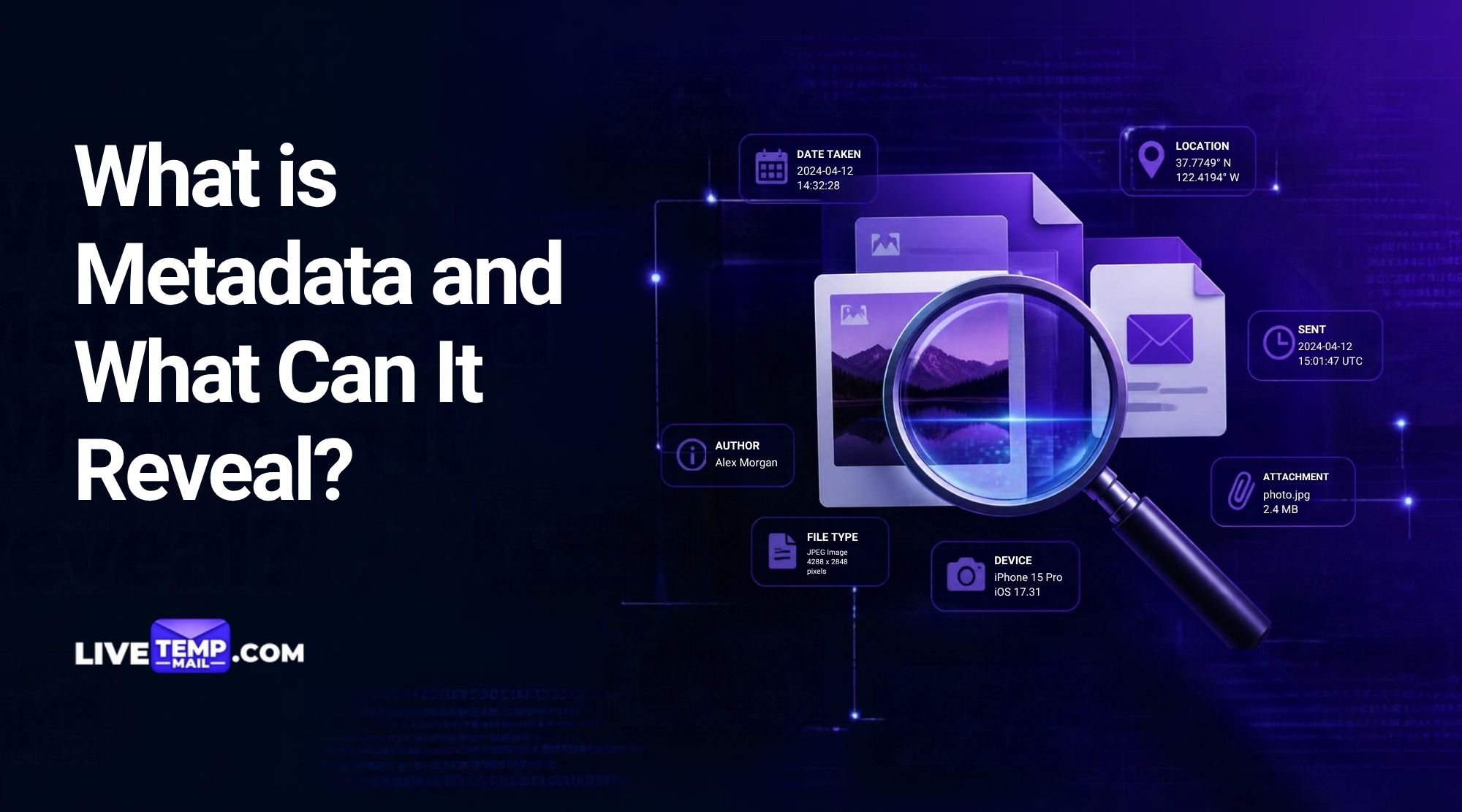
1. Photo Metadata (EXIF Data): When you take a picture using your mobile phone or laptop camera, numerous hidden details are saved alongside the image file (.jpg or .png); this is known as EXIF (Exchangeable Image File Format) data. It includes:
The date and time the picture was taken
Device information (e.g., camera model or laptop details)
Camera settings (aperture, shutter speed)
GPS Location: If your device's location services are enabled, the exact coordinates of where the photo was taken are also saved in the metadata.
2. Emails and Messages: When you send an email, the message itself is accompanied by a significant amount of metadata in the email header. This includes the sender's and receiver's IP addresses, routing server details, the time of transmission, and basic device information.
3. Web Pages and Web Scraping: The source code of any website is replete with metadata. HTML tags (such as ``, ``</span></span><span style="background-color:transparent;color:#000000;font-family:Arial,sans-serif;font-size:11pt;"><span style="font-style:normal;font-variant:normal;font-weight:400;text-decoration:none;vertical-align:baseline;white-space:pre-wrap;">, and schema markups) inform search engines and web scrapers about the subject matter of a page. When performing web scraping using automated tools, the page's metadata is the first resource that helps you filter its structure and content.</span></span></p><p style="line-height:1.656;margin-bottom:12pt;margin-top:12pt;" dir="ltr"><span style="background-color:transparent;color:#000000;font-family:Arial,sans-serif;font-size:11pt;"><span style="font-style:normal;font-variant:normal;font-weight:400;text-decoration:none;vertical-align:baseline;white-space:pre-wrap;"><strong>4. Files and Documents:</strong> If you right-click on any Word document or PDF and select 'Properties', you can view that file's metadata. This includes details such as the author's name, creation date, modification date, and the number of times the file has been edited.</span></span></p><h5><span style="background-color:transparent;color:#000000;font-family:Arial,sans-serif;font-size:11pt;"><span style="font-style:normal;font-variant:normal;font-weight:400;text-decoration:none;vertical-align:baseline;white-space:pre-wrap;"><strong>What Can Metadata Reveal?</strong></span></span></h5><p style="line-height:1.656;margin-bottom:12pt;margin-top:12pt;" dir="ltr"><span style="background-color:transparent;color:#000000;font-family:Arial,sans-serif;font-size:11pt;"><span style="font-style:normal;font-variant:normal;font-weight:400;text-decoration:none;vertical-align:baseline;white-space:pre-wrap;">Now, let’s address the most crucial part of this question. If metadata is merely "data about data," why is it so powerful or sensitive? The reality is that even if someone possesses only your metadata (without the actual data itself), they can still glean deep insights into your life.</span></span></p><p style="line-height:1.656;margin-bottom:12pt;margin-top:12pt;" dir="ltr"><span style="background-color:transparent;color:#000000;font-family:Arial,sans-serif;font-size:11pt;"><span style="font-style:normal;font-variant:normal;font-weight:400;text-decoration:none;vertical-align:baseline;white-space:pre-wrap;"><strong>1. Your Location and Movements:</strong> If the metadata from your photos, social media posts, and apps is analyzed, anyone can easily map out your daily movements. Details such as when you go to university, when you work out at the gym or on a treadmill, and where you spend your weekends are all hidden within metadata. EXIF data and IP addresses can pinpoint your exact physical location.</span></span></p><p style="line-height:1.656;margin-bottom:12pt;margin-top:12pt;" dir="ltr"><span style="background-color:transparent;color:#000000;font-family:Arial,sans-serif;font-size:11pt;"><span style="font-style:normal;font-variant:normal;font-weight:400;text-decoration:none;vertical-align:baseline;white-space:pre-wrap;"><strong>2. Your Daily Routine and Habits: </strong>When you come online, when you sleep, which applications you use, and when you start coding or development work on your laptop, all of this can be determined using timestamps. If a server log records the timing of your file uploads and commits, that metadata can be used to track your entire work schedule.</span></span></p><p style="line-height:1.656;margin-bottom:12pt;margin-top:12pt;" dir="ltr"><span style="background-color:transparent;color:#000000;font-family:Arial,sans-serif;font-size:11pt;"><span style="font-style:normal;font-variant:normal;font-weight:400;text-decoration:none;vertical-align:baseline;white-space:pre-wrap;"><strong>3. Your Social Circle and Relationships:</strong> Even if no one can read the actual content of your messages, metadata can reveal whom you communicate with most frequently. If a large number of emails or messages are exchanged between "Person A" and "Person B" at 2:00 AM, the frequency and timing of these interactions can provide clues about the depth of their relationship. Intelligence agencies and data brokers utilize this type of network analysis. 4. Your Interests and Preferences: When you browse the internet, cookies and tracking scripts collect your metadata. Companies use data regarding the types of web pages where you linger and the tools you search for (such as AI models, web scraping tools, or app development frameworks) to create a profile of you. Targeted advertisements are displayed to you based on this metadata.</span></span></p><p style="line-height:1.656;margin-bottom:12pt;margin-top:12pt;" dir="ltr"><span style="background-color:transparent;color:#000000;font-family:Arial,sans-serif;font-size:11pt;"><span style="font-style:normal;font-variant:normal;font-weight:400;text-decoration:none;vertical-align:baseline;white-space:pre-wrap;"><strong>5. Device and Infrastructure Information: </strong>Websites learn details such as your operating system, hardware specifications, screen resolution, and web browser through HTTP headers and user-agent strings (which are forms of metadata). Hackers can use this information to plan specific cyber-attacks against your device.</span></span></p><h5><span style="background-color:transparent;color:#000000;font-family:Arial,sans-serif;font-size:11pt;"><span style="font-style:normal;font-variant:normal;font-weight:400;text-decoration:none;vertical-align:baseline;white-space:pre-wrap;"><strong>Privacy Concerns and Protecting Metadata</strong></span></span></h5><p style="line-height:1.656;margin-bottom:12pt;margin-top:12pt;" dir="ltr"><span style="background-color:transparent;color:#000000;font-family:Arial,sans-serif;font-size:11pt;"><span style="font-style:normal;font-variant:normal;font-weight:400;text-decoration:none;vertical-align:baseline;white-space:pre-wrap;">The biggest issue with metadata is that it usually remains hidden from our view. We often send files to others without realizing that our personal details are being transmitted along with them. Major tech companies and data brokers collect this metadata, analyze it using AI and machine learning algorithms, and build profiles of us that may reveal details even we are unaware of.</span></span></p><p style="line-height:1.656;margin-bottom:12pt;margin-top:12pt;" dir="ltr"><span style="background-color:transparent;color:#000000;font-family:Arial,sans-serif;font-size:11pt;"><span style="font-style:normal;font-variant:normal;font-weight:400;text-decoration:none;vertical-align:baseline;white-space:pre-wrap;">Some basic steps can be taken to keep your metadata secure. First, whenever you share a photo on a public platform, try to remove its EXIF data (while many websites do this automatically upon upload, it is better to check manually). Disable 'Location Permission' and 'Background Data' access on your smartphone for apps that do not require them. During development, when deploying an app or website, ensure that development files or API keys are not inadvertently exposed in the production metadata. Additionally, using a VPN for sensitive browsing or scraping tasks can help mask your IP address and network metadata.</span></span></p><p style="line-height:1.656;margin-bottom:12pt;margin-top:12pt;" dir="ltr"><span style="background-color:transparent;color:#000000;font-family:Arial,sans-serif;font-size:11pt;"><span style="font-style:normal;font-variant:normal;font-weight:400;text-decoration:none;vertical-align:baseline;white-space:pre-wrap;">In the digital realm, metadata is just as valuable as the actual data itself. It serves as a silent witness to our digital lives, recording every step, click, and connection we make; therefore, understanding and protecting it is crucial for our online security.</span></span></p>
Tags:
#metadata
#privacy
#online privacy
Share this page